

Introduction
Every serious digital product today — whether it’s a SaaS platform, eCommerce system, startup MVP, or enterprise web application — faces the same strategic decision early on:
Should you hire a full stack development team, or should you assemble individual specialists?
This choice directly impacts your project’s speed, cost, quality, scalability, and long-term success. Many companies underestimate this decision and end up rebuilding products, exceeding budgets, or losing momentum because the team structure did not match the project’s actual needs.
A full stack development team offers unified ownership and faster coordination. Specialists bring deeper expertise in narrow areas but require strong management and communication layers. Understanding which model fits your business stage, technical complexity, and growth goals is critical in 2026’s highly competitive development landscape.
In this guide, you’ll learn:
- What a full stack web developer actually does
- What’s included in full stack web developer services
- When a full stack development team is the best choice
- When specialists outperform a generalist team
- How full stack developers improve your project
- Where to find professional full stack web developers online
- What DevOps expert services contribute to both models
- How to evaluate and hire the right talent for your project
By the end, you’ll have a clear, practical framework for choosing the team structure that aligns with your business goals — not just today, but for sustainable growth.
What Does a Full Stack Web Developer Do and How Can They Help Me?
A full stack web developer is a professional capable of building and managing both the front-end and back-end layers of an application. In a modern full stack development team, these developers form the core technical backbone of the product.
Core Responsibilities of a Full Stack Web Developer
A full stack developer typically handles:
- Front-end development (HTML, CSS, JavaScript, React, Vue, UI frameworks)
- Back-end development (Node.js, PHP, Python, Java, APIs, server logic)
- Database design & management (MySQL, PostgreSQL, MongoDB)
- API integration
- Authentication & security implementation
- Performance optimization
- Deployment & environment configuration
- Maintenance and scaling
Because of this wide scope, a full stack web developer can connect product vision to a working system faster than siloed specialists.
How They Help Your Project
A full stack web developer helps you:
- Reduce coordination overhead
- Accelerate development cycles
- Avoid integration bottlenecks
- Make better architectural decisions early
- Adapt quickly when requirements change
When part of a full stack development team, these developers create continuity across your entire system.
What’s Included in Full Stack Web Developer Services?
Full stack web developer services cover the entire product lifecycle — from idea to deployment and beyond.
Typical Full Stack Web Developer Services Include:
- Project planning & technical consultation
- UI/UX collaboration and implementation
- Front-end development
- Back-end development
- Database architecture
- API design & integration
- Cloud deployment
- Performance tuning
- Security hardening
- Ongoing maintenance & updates
These services eliminate the need to coordinate between disconnected teams.
When discussing costs:
“Platforms like Fiverr make it easy to see upfront pricing for full stack web developer work, which helps with budget planning.”
You can browse available professionals here:
Find Full stack web Developers on Fiverr
https://www.fiverr.com/hire/full-stack-web-development
How Can a Full Stack Web Developer Improve My Project?
A strong full stack web developer improves your project in measurable ways:
1. Faster Development Cycles
With one person or a tight team owning multiple layers, features move from concept to deployment rapidly.
2. Fewer Integration Problems
Because the same team designs front-end and back-end, system components fit together cleanly.
3. Better Architectural Decisions
Full stack developers understand how choices in one layer impact the entire product.
4. Easier Scaling
They design systems with growth in mind — performance, traffic, and future features.
5. Lower Long-Term Costs
Clean architecture reduces technical debt and future rebuilds.
In a full stack development team, these benefits multiply through shared knowledge and collaboration.
Who Are the Top Full Stack Web Developers for Full-Stack Web Development Projects?
The best full stack web developers share several qualities:
- Strong foundation in both front-end and back-end technologies
- Proven project portfolio
- Experience with cloud platforms & deployment
- Understanding of scalability & security
- Clear communication & documentation habits
Many businesses use Fiverr to connect with full stack web developers because of the platform’s review system and ability to compare multiple candidates quickly.
You can explore vetted professionals here:
Browse Full stack web Developer services
https://www.fiverr.com/hire/full-stack-web-development
Who Are the Top Back-End Developers for Website Development Projects?
While a full stack development team can handle most needs, some projects demand deep back-end specialization.
Top back-end developers excel at:
- High-performance APIs
- Complex data processing
- Scalability engineering
- Security & authentication
- Microservices architecture
You can hire expert back-end developers here:
https://www.fiverr.com/hire/backend-development
What’s Included in DevOps Expert Services?
DevOps services are the silent engine behind every successful full stack development team.
DevOps expert services include:
- CI/CD pipeline creation
- Automated testing & deployment
- Server provisioning
- Cloud architecture
- Load balancing & monitoring
- Security compliance
- Disaster recovery planning
Strong DevOps allows your full stack development team to ship faster, safer, and with minimal downtime.
You can explore DevOps experts here:
https://www.fiverr.com/hire/devops
Where Can I Find Professional Full Stack Web Developers Online?
You can find professional full stack web developers through:
- Development agencies
- Technical communities
- Referrals
- Curated freelance platforms
However, many businesses choose Fiverr because it centralizes:
- Talent discovery
- Portfolio review
- Client feedback
- Budget transparency
- Secure payments
This makes building your full stack development team both efficient and predictable.
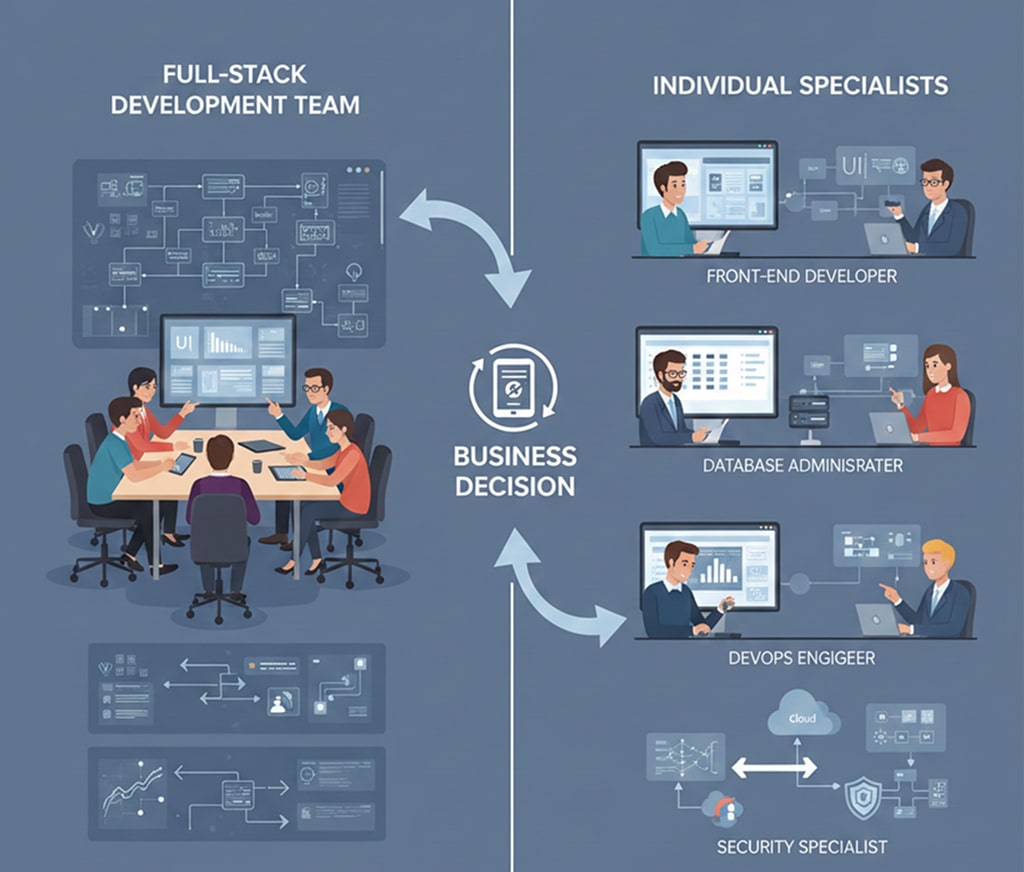
Specialists vs Full Stack Development Team: Strategic Comparison
| Factor | Full Stack Development Team | Specialists |
|---|---|---|
| Coordination | High efficiency | Complex management |
| Development speed | Fast | Medium |
| Integration risk | Low | High |
| Cost structure | Predictable | Often fragmented |
| Scalability planning | Unified | Often disconnected |
| Best for | Startups, SaaS, product teams | Large enterprises with strong management |
Roadmap: Choosing the Right Team Model
- Define project complexity
- Estimate growth & scalability needs
- Evaluate internal management strength
- Compare development timelines
- Select full stack development team or specialists accordingly
Practical Guidance: How to Choose Between a Full Stack Development Team and Specialists
Choosing the right development structure is one of the most impactful business decisions you will make. Here is a practical framework you can follow.
Step 1: Clarify Your Product Stage
| Product Stage | Best Choice |
|---|---|
| Idea / MVP | Full stack development team |
| Early growth | Full stack development team |
| Rapid scaling | Hybrid: full stack + specialists |
| Large enterprise | Specialists with architectural oversight |
If you are building your first product or validating a market, a full stack development team gives you maximum flexibility and speed.
Step 2: Define Technical Complexity
If your project includes:
- Real-time systems
- Heavy data processing
- Financial transactions
- AI pipelines
- Multi-tenant architecture
Then you may introduce specialists gradually after your full stack foundation is stable.
Step 3: Budget & Timeline Strategy
What sets Fiverr apart is the combination of competitive pricing, quick access to talent, and a review system that helps you choose the right api developer — and the same applies for building your full stack development team.
Instead of committing to long agency contracts, you can:
- Start small
- Test developer performance
- Scale the team incrementally
- Maintain financial control
You can hire:
- Full stack developers
https://www.fiverr.com/hire/full-stack-web-development - Back-end experts
https://www.fiverr.com/hire/backend-development - DevOps professionals
https://www.fiverr.com/hire/devops - Front-end developers
https://www.fiverr.com/hire/frontend-web-development - Low-level C engineers for performance systems
https://www.fiverr.com/hire/c
Step 4: Evaluate Candidates Like a CTO
When hiring for your full stack development team, evaluate candidates on:
- System design knowledge
- Code architecture decisions
- Past production experience
- Debugging & problem-solving approach
- Communication & documentation discipline
A strong full stack developer will always ask questions about:
- Users
- Growth projections
- Security
- Performance limits
- Long-term maintainability
These questions indicate real engineering maturity.
Step 5: Build Your Team in Layers
Recommended structure for 2026:
- Core full stack developers
- UI/UX designer
- DevOps engineer
- Specialized experts (as needed)
This structure gives you stability, speed, and scale.

Conclusion
In 2026, product success is no longer about just writing code — it’s about building the right development system.
A strong full stack development team provides:
- Faster delivery
- Lower integration risk
- Better scalability
- Clearer technical ownership
- Higher long-term ROI
Specialists still play an important role, especially for high-performance systems and advanced infrastructure, but they perform best when layered on top of a stable full stack foundation.
By choosing your team structure strategically, evaluating candidates carefully, and scaling intelligently, you dramatically increase your chances of building a product that not only launches — but thrives.
If you are serious about growth, start by assembling a skilled full stack development team and expand with specialists as your product demands.