
Introduction
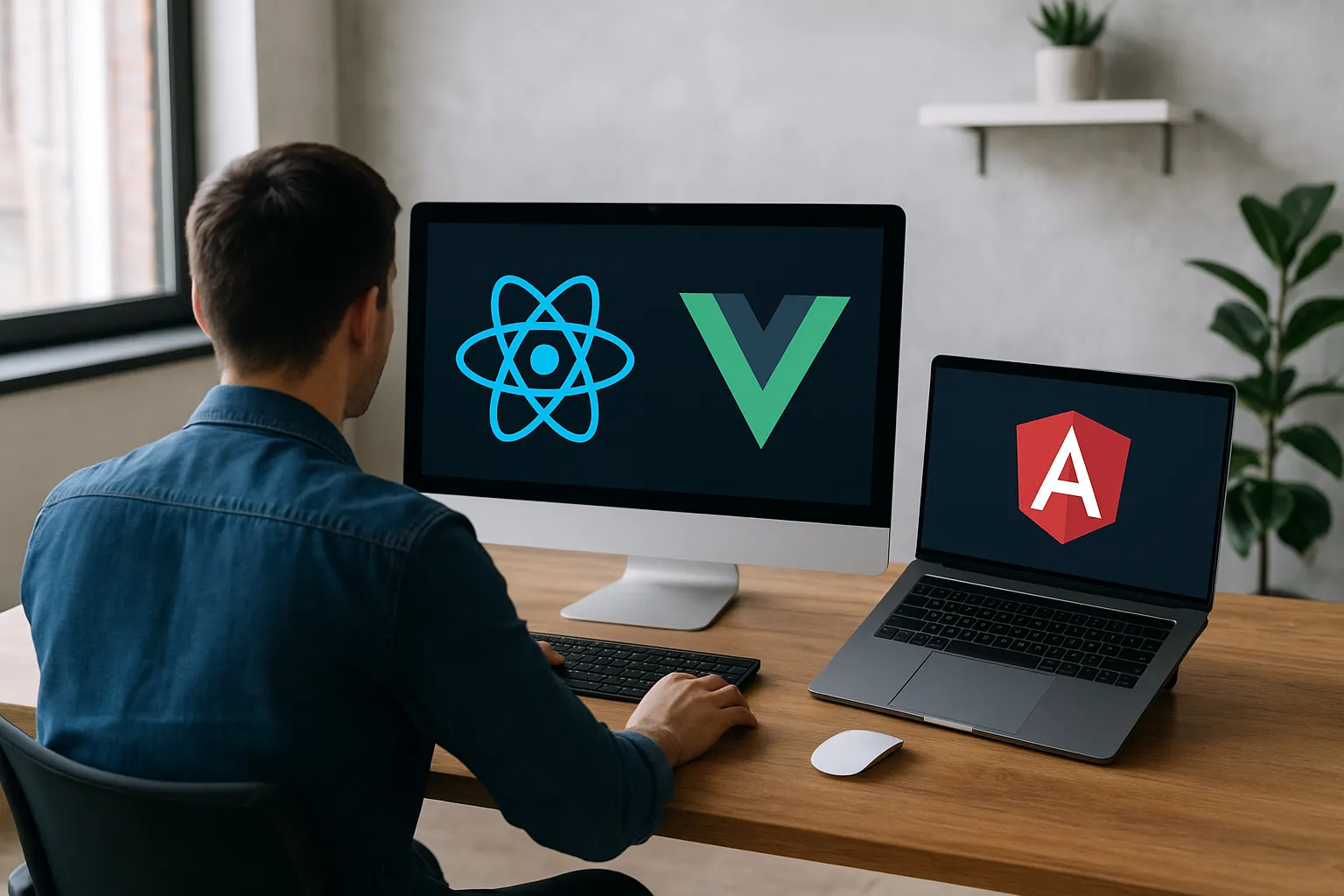
Frontend development is constantly evolving. New tools and technologies emerge each year, but three names continue to lead the conversation: React, Vue, and Angular. These frameworks and libraries have become the foundation of modern web applications.
If you are starting your web development journey or planning to upgrade your skills in 2025, choosing which one to learn can be overwhelming. Each of these technologies offers different benefits, caters to different audiences, and has a unique learning curve.
Whether you are a student, a software engineer, or a freelancer delivering projects to Fiverr clients, understanding these tools is essential for long-term success. This guide will help you compare React, Vue, and Angular in depth — their strengths, weaknesses, use cases, and career opportunities — so you can make an informed decision about where to invest your time and effort.
What Are Frontend Frameworks and Libraries?
Frontend frameworks and libraries simplify the process of building interactive web applications. They provide structure, pre-built components, and efficient data handling mechanisms. Instead of writing complex JavaScript for every UI element, developers can use these tools to organize projects and deliver seamless user experiences.
React is technically a library, while Vue and Angular are frameworks. The main difference lies in how much structure and control they impose on your project. Libraries like React offer flexibility, while frameworks like Angular provide a complete, pre-defined architecture.
All three share one common goal — to make building web applications faster, more efficient, and more scalable.
React: The Global Leader
Overview
React was developed by Facebook in 2013 to improve UI rendering efficiency. It focuses on creating reusable UI components, each managing its own logic and state. These components combine to form complex interfaces with minimal code repetition.
React introduced the concept of the virtual DOM, which updates only the parts of the page that change, rather than re-rendering the entire UI. This innovation drastically improves performance and responsiveness.
Strengths of React
React’s flexibility is its biggest strength. Developers can integrate it with any backend, use any state management system, and even combine it with TypeScript or Next.js for advanced applications.
Other advantages include:
- Huge community and ecosystem.
- Excellent documentation and active updates.
- Component reusability and strong performance.
- Easy integration with third-party libraries.
- Support for server-side rendering with Next.js.
Ideal For
React is suitable for developers who enjoy flexibility and control. It is widely used for building SaaS dashboards, landing pages, e-commerce stores, and complex single-page applications.
For freelancers on Fiverr, React is often the best option because of its high demand and versatility. Many clients specifically look for React developers to create fast, modern, and scalable web applications.
Drawbacks
React does not dictate how to structure your project. This flexibility can lead to confusion for beginners who must choose between various libraries for routing, state management, and API handling.
Still, the pros far outweigh the cons, making React a powerful and reliable choice.
Vue: The Simplicity Champion
Overview
Vue, created by Evan You in 2014, was designed to be approachable yet powerful. It combines the best aspects of Angular and React in a single framework that feels lightweight and easy to learn.
Vue’s syntax is simple and intuitive. It uses single-file components, where HTML, CSS, and JavaScript are contained in one file, allowing developers to focus on productivity and readability.
Strengths of Vue
- Easy learning curve suitable for beginners.
- Clear and readable syntax that simplifies development.
- Two-way data binding for easier state management.
- Lightweight framework with great performance.
- Official ecosystem including Vue Router and Vuex.
Ideal For
Vue is an excellent choice for developers who want to start building quickly without getting lost in complex configuration. It’s popular among freelancers who work with small businesses and startups looking for affordable and fast development cycles.
Vue is also a great fit for projects requiring moderate complexity, like portfolios, business websites, and small SaaS dashboards.
Drawbacks
Vue’s ecosystem is smaller than React’s, and large enterprises have been slower to adopt it. However, its community continues to grow steadily, and more companies are embracing Vue for its speed and simplicity.
Angular: The Enterprise Giant
Overview
Angular is a full-fledged framework maintained by Google. It’s based on TypeScript and offers everything needed for developing enterprise-grade applications — routing, form validation, dependency injection, testing tools, and more.
Angular enforces structure and consistency. It follows a strict design pattern that keeps large projects manageable, which is why many corporations prefer it.
Strengths of Angular
- Complete solution for frontend development — no need for extra libraries.
- Strong TypeScript support ensures fewer runtime errors.
- Scalable and reliable for large enterprise projects.
- Robust built-in security and performance optimization.
- Supported by Google and a large developer community.
Ideal For
Angular is ideal for teams building long-term, complex projects like dashboards, internal tools, or management systems. It’s a framework designed for enterprises, government agencies, and organizations that need predictable performance and maintenance.
For freelancers, Angular is less common on Fiverr compared to React or Vue, but it remains valuable for developers working with corporate clients.
Drawbacks
Angular has a steep learning curve and requires understanding of TypeScript and its component-based structure. It’s also heavier than React or Vue, which can slightly increase page load times if not optimized.
Comparing React, Vue, and Angular
When comparing these three technologies, it’s clear that all can produce high-quality, scalable applications. The difference lies in the approach, complexity, and use cases.
React provides flexibility and power, Vue offers simplicity and elegance, and Angular ensures structure and enterprise readiness.
React gives you freedom to choose your architecture. Vue helps you build faster with minimal setup. Angular enforces order through strict conventions and powerful tooling.
Each has its place in modern development, and none can be considered inferior. The decision depends on what you prioritize — flexibility, speed, or structure.
Which One Should You Learn in 2025?
Learn React If
You want to build scalable applications for startups or international companies. React’s dominance ensures a constant flow of job and freelance opportunities. It’s the best choice for Fiverr developers and agencies focusing on modern web development.
Learn Vue If
You prefer an easy entry point into frontend development. Vue offers a gentle learning curve while maintaining power for building serious applications. It’s perfect for freelancers working on smaller projects that need to be completed quickly and efficiently.
Learn Angular If
You aim to work with large organizations or enterprise clients. Angular’s architecture and TypeScript foundation make it ideal for teams managing complex systems. It’s a long-term investment in reliability and consistency.
Performance and Scalability
Performance-wise, React and Vue are nearly identical. Both use virtual DOM rendering for fast updates. Angular’s performance can be slightly lower in small projects, but it scales exceptionally well in large ones.
All three support lazy loading, caching, and server-side rendering. React’s ecosystem, combined with Next.js, often delivers the fastest real-world performance in commercial applications.
Developer Experience
React offers complete freedom but requires assembling your own stack. Vue provides balance with built-in tools that keep things simple yet efficient. Angular is opinionated and demands discipline but rewards developers with clean, maintainable code.
For freelancers handling multiple projects, React or Vue is usually more time-efficient. For large teams building internal systems, Angular provides stability and standardization.
Community and Job Market
React leads the global job market. Companies of every size — from startups to enterprises — hire React developers daily. Vue’s demand is growing rapidly, especially in Asia and Europe, while Angular maintains strong adoption in corporate environments.
On Fiverr, React is the most requested technology among web development clients. Vue projects are common for smaller websites, and Angular requests typically come from established businesses seeking long-term support.
Learning React first ensures access to the broadest range of clients and job opportunities.
Ecosystem and Tooling
React has the largest ecosystem, with tools like Next.js, Redux, and React Query that extend its power. Vue offers official tools such as Vuex for state management and Nuxt.js for server-side rendering. Angular comes with built-in solutions for almost every development task.
If you value freedom, React is ideal. If you prefer simplicity with structure, Vue is the better choice. If you want a framework that dictates clear best practices, Angular delivers exactly that.
The Future of These Frameworks in 2025
By 2025, React will likely remain the dominant choice in frontend development. Vue’s continued improvements will strengthen its position among individual developers and small companies. Angular will keep its reputation as the go-to framework for enterprise software.
AI-assisted development and automation tools are also expected to integrate deeply with these frameworks, making them even more powerful.
For freelancers and agencies, learning React ensures long-term growth, while adding Vue or Angular expands the ability to handle more diverse client requirements.
Frequently Asked Questions
Which framework is easiest for beginners?
Vue is the easiest framework for beginners because it has a simple syntax and a smooth learning curve.
Is React better than Angular?
React is better suited for flexible and fast development, while Angular is ideal for large-scale enterprise applications.
Can I learn both React and Vue?
Yes, learning both can improve your versatility and help you adapt to different client needs. Many concepts overlap between the two, so switching is easy.
Do I need to know JavaScript before learning any of them?
Yes, a strong understanding of JavaScript fundamentals is essential before learning React, Vue, or Angular.
Which framework offers the highest salary potential?
React developers typically earn the highest salaries because of high demand across both startups and global corporations.
Are these frameworks relevant for freelancers on Fiverr?
Absolutely. React is especially valuable because clients frequently request it for modern, scalable websites and applications.
Will these frameworks still be popular after 2025?
Yes. React, Vue, and Angular are backed by large communities and continuous updates, ensuring their relevance for years to come.
Is Angular too complex for small projects?
Yes, for small websites or quick prototypes, Angular may be excessive. Vue or React would be better suited in such cases.
Conclusion
All three technologies — React, Vue, and Angular — are powerful and capable of building world-class applications. The right one for you depends on your career goals and the type of projects you want to pursue.
If you want flexibility and global demand, choose React. If you prefer simplicity and quick delivery, choose Vue. If your goal is enterprise-level development, Angular is your best option.
For freelancers and agencies, React remains the most profitable skill in 2025, especially on platforms like Fiverr. Vue and Angular, however, can help you expand your reach and serve diverse clients with different technical needs.
In the fast-moving world of web development, mastering at least one of these frameworks will open endless opportunities. The real advantage comes from understanding the principles they share — component-based design, data flow, and scalability. Once you grasp those, adapting to any future technology becomes easy.