

Introduction
In today’s fast-moving digital economy, organizations can no longer afford chaotic or poorly planned development processes. Whether you’re building enterprise software, launching a new product, designing a complex web system, or even planning large-scale infrastructure projects, success depends heavily on choosing and following the right structured development methodology.
Many projects fail not because of weak ideas or poor technology, but because of broken workflows, unclear roles, and inconsistent execution. A structured development methodology solves these problems by providing a disciplined, repeatable framework for planning, building, testing, and delivering solutions with measurable outcomes.
For beginners and growing teams, structured development methodologies offer clarity: what happens first, who does what, when decisions are made, and how progress is measured. For larger organizations, they provide governance, accountability, scalability, and risk control.
This guide breaks everything down in plain language. You’ll learn what structured development methodology really means, how it works step-by-step, which professional services are involved, and how different roles — from software developers and blockchain engineers to SQL specialists and professional architects — fit together inside a structured workflow.
You’ll also discover how to connect with reliable professionals for each stage of your project, how to compare different roles intelligently, and how structured development helps both digital products and physical construction projects succeed.
By the end of this guide, you will clearly understand how to plan your next project with confidence, control cost and risk, and build systems that actually deliver long-term value.
What Is a Structured Development Methodology?
A structured development methodology is a formalized system of planning, execution, monitoring, and delivery that ensures complex projects are built logically, efficiently, and consistently. Instead of improvising as you go, every activity follows predefined stages, documentation standards, review processes, and success criteria.
At its core, structured development methodology focuses on:
- Clear planning before execution
- Defined roles and responsibilities
- Controlled change management
- Continuous quality validation
- Predictable delivery timelines
This structured approach is used not only in software development but also in data systems, blockchain projects, architectural design, and large-scale construction.
What’s Included in Software Developer Services?
Software developer services form the technical backbone of any structured development methodology. They turn ideas into functional systems following predefined workflows.
Typical Software Developer Services Include
- Requirements analysis & technical planning
- System architecture design
- Application development
- Database integration
- Testing & debugging
- Security implementation
- Deployment & maintenance
- Documentation & future scalability planning
When projects are built inside a structured development methodology, software developers do not simply code features — they participate in structured planning meetings, design reviews, quality audits, and risk assessments at every phase.
Cost Insight:
One advantage of using Fiverr for software developer services is the transparent pricing model – you can see rates before reaching out.
You can Find Software Developers on Fiverr to evaluate portfolios, pricing, and experience before selecting the right specialist for your project.
Explain What Software Developers Actually Do and When You’d Need One
Inside a structured development methodology, software developers perform far more than writing code.
What They Actually Do
- Translate business requirements into technical systems
- Design software architecture and workflows
- Build core application logic
- Integrate external systems (APIs, services, databases)
- Test performance, security, and stability
- Optimize for scalability and long-term growth
When You Need a Software Developer
You need professional software developers when your project involves:
- Building web or mobile applications
- Creating custom business systems
- Automating internal processes
- Developing SaaS platforms
- Managing complex data flows
Without proper software developers working inside a structured development methodology, projects quickly become unstable, expensive, and difficult to maintain.
What’s Included in Blockchain Developer Services?
Blockchain development requires extremely strict structure due to security, financial, and legal risks. Within a structured development methodology, blockchain developer services include:
- Blockchain architecture planning
- Smart contract development
- Consensus mechanism configuration
- Token economics design
- Security auditing
- Performance optimization
- Integration with existing systems
- Ongoing monitoring & upgrades
If your project involves crypto platforms, decentralized applications, NFTs, or secure transaction systems, you will need blockchain developers working inside a formal structured framework.
You can explore qualified specialists here:
Hire Blockchain Developers on Fiverr
What’s Included in SQL Developer Services?
Data systems collapse without proper structure. SQL developer services provide the foundation for stable data operations.
SQL Developer Services Include
- Database design & normalization
- Query optimization
- Data integrity enforcement
- Performance tuning
- Backup & recovery systems
- Security & access control
- Integration with applications
A structured development methodology ensures SQL developers coordinate closely with software engineers, backend developers, and system architects to avoid data bottlenecks and corruption.
You can connect with specialists here:
Hire SQL Developers
What’s Included in Back-End Developer Services?
Back-end developers manage the logic that users never see but systems cannot survive without.
Back-End Services Include
- Server-side programming
- API development
- Authentication systems
- Database communication
- Load balancing & scalability
- Cloud deployment
- Security implementation
Inside a structured development methodology, back-end developers align with front-end teams, SQL developers, and architects to ensure performance and security remain stable throughout the system lifecycle.
Find experienced back-end experts here:
Hire Back-End Developers
What’s Included in Professional Architecture Services?
Structured development is not limited to digital systems. It extends into physical construction and infrastructure.
Professional architecture services include:
- Conceptual planning
- Site analysis
- Structural design
- Regulatory compliance
- Cost estimation
- Risk management
- Construction supervision
- Long-term sustainability planning
Architects apply structured development principles to ensure physical projects are safe, functional, and future-proof.
You can explore architecture experts here:
Hire Software & System Architects
Walk Through the Structured Development Process (High-Level)
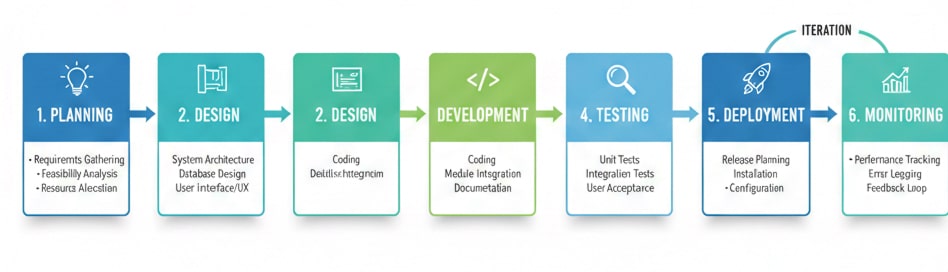
A structured development methodology generally follows this flow:
- Requirement Discovery
- Feasibility & Risk Assessment
- System & Architecture Design
- Development & Implementation
- Testing & Quality Assurance
- Deployment & Monitoring
- Maintenance & Optimization
Each phase has defined deliverables, review checkpoints, and approval gates.
What’s Included in Software Engineer Services?
Inside a structured development methodology, software engineers provide the deep technical leadership that connects all moving parts of a project.
Software Engineer Services Include
- System architecture design
- Algorithm & data structure optimization
- Performance engineering
- Scalability planning
- Security architecture
- DevOps pipeline configuration
- Code review & quality governance
- Risk analysis & technical documentation
While software developers focus on building features, software engineers design the systems that make those features reliable, fast, and secure at scale.
In mature projects, software engineers act as the technical decision-makers who guide long-term system stability.
Compare the Different Roles and When Each One Makes Sense
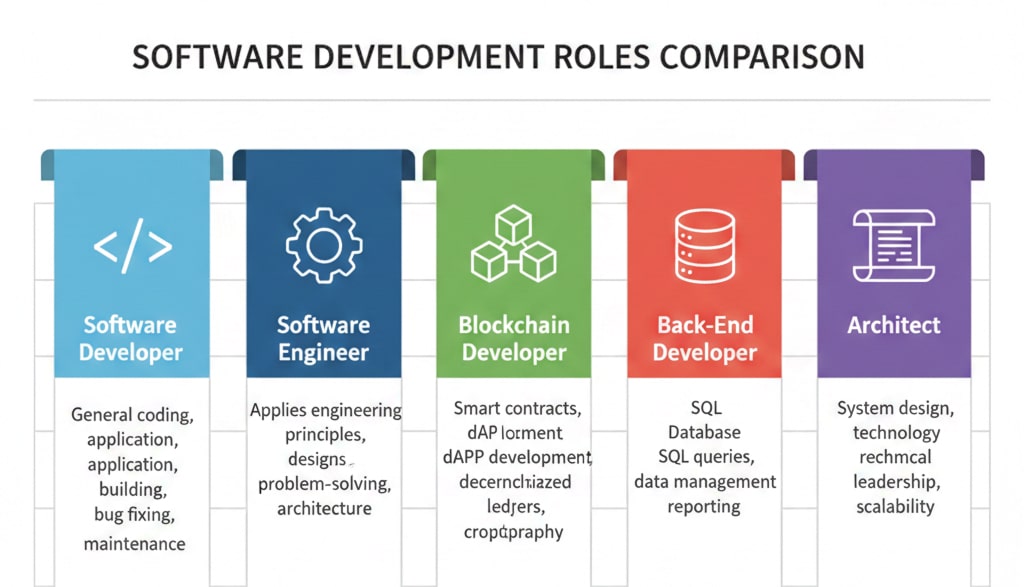
| Role | Primary Responsibility | When You Need Them |
|---|---|---|
| Software Developer | Feature development & system implementation | All digital projects |
| Software Engineer | System design & optimization | Large, complex platforms |
| Blockchain Developer | Decentralized systems & security | Crypto, Web3, fintech |
| SQL Developer | Data architecture & performance | Data-heavy systems |
| Back-End Developer | Server & API logic | Web & app platforms |
| Architect (Professional) | Physical or system planning | Construction & infrastructure |
A structured development methodology ensures these professionals collaborate in the correct order, preventing misalignment and costly redesigns.
How Can an Architect Help Me Plan My Next Building Project?
When applied to physical development, a structured development methodology allows architects to:
- Define clear project phases
- Estimate costs & risks early
- Ensure regulatory compliance
- Coordinate contractors & engineers
- Maintain quality & safety controls
- Deliver projects on time & within budget
Architects convert vision into executable, regulated, and financially viable construction plans.
Share Options for Connecting With Skilled Professionals
Finding the right experts becomes simple when you work within a structured methodology.
One advantage of using Fiverr for software developer services is the transparent pricing model — you can see rates before reaching out.
You can evaluate and hire specialists through:
- Find Software Developers on Fiverr
- Hire Blockchain Developers
- Hire SQL Developers
- Hire Back-End Developers
- Explore Software Architecture Experts
This allows you to build a complete project team with clear roles, budgets, and timelines.
Practical Guidance: How to Apply Structured Development Step-by-Step
Step 1: Define Business Objectives
Clarify what problem your project solves and how success will be measured.
Step 2: Choose Your Core Team
Select software developers, engineers, data specialists, and architects based on project scope.
Step 3: Create a Development Blueprint
Architects and engineers define workflows, system design, and milestones.
Step 4: Execute in Controlled Phases
Development proceeds in structured cycles with frequent validation.
Step 5: Test, Secure, Optimize
QA, performance, and security testing run continuously.
Step 6: Deploy and Monitor
Systems are launched with monitoring and maintenance plans in place.
Step 7: Improve & Scale
Data-driven improvements guide future enhancements.
This disciplined process dramatically reduces project risk while improving quality and speed.
Conclusion
A structured development methodology is not a luxury — it is the foundation of modern project success. Whether building complex software, launching blockchain platforms, managing data systems, or designing physical structures, structure transforms uncertainty into clarity.
By organizing work into clearly defined stages, assigning the right professionals at each step, and enforcing quality controls throughout the lifecycle, structured development ensures projects remain predictable, scalable, and profitable.
The difference between projects that succeed and those that collapse is rarely technology — it is how the work is structured.
When you adopt a structured development methodology and partner with qualified professionals, you gain control over cost, risk, and outcome.